
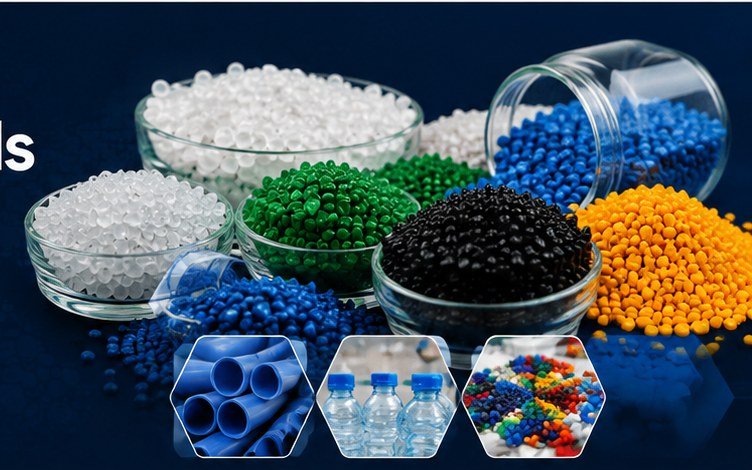
Fundamental Classification of Polymers
In polymer science, all synthetic and semi-synthetic resins are broadly divided into two foundational classes based on their response to thermal energy: Thermoplastics and Thermosets (Thermosetting polymers). This classification is determined by the presence or absence of covalent cross-links between molecular chains.
1. Structural Differences and Molecular Behavior
| Feature | Thermoplastics | Thermosets (Thermosetting Resins) |
|---|---|---|
| Chemical Bonding | Linear or branched chains held by weak secondary Van der Waals and hydrogen bonds. | Three-dimensional networks connected by permanent, irreversible covalent cross-links. |
| Thermal Behavior | Melts into a viscous liquid upon heating; resolidifies upon cooling. Process is repeatable. | Cures permanently during synthesis; decomposes and chars upon reheating rather than melting. |
| Mechanical Recyclability | 100% mechanically recyclable via shredding and remelting. | Cannot be remelted. Must be downcycled as filler powder or chemically pyrolyzed. |
| Creep & Thermal Resistance | Moderate to high; subject to thermal softening and structural creep under constant load. | High thermal stability, high dimensional rigidity, and resistance to creep. |
| Chemical Solvent Resistance | Can be swollen or dissolved by specific organic solvents. | Insoluble and highly resistant to chemical attack and environmental stress cracking. |
2. Common Industrial Materials in Each Class
Key Thermoplastics
- Polyethylene (PE), Polypropylene (PP), Polyethylene Terephthalate (PET).
- Polycarbonate (PC), Polyamides (Nylon / PA), Acrylonitrile Butadiene Styrene (ABS).
- Polyether ether ketone (PEEK) and Fluoropolymers (PTFE / Teflon).
Key Thermosets
- Epoxy Resins: High-performance matrices for carbon-fiber composites and aerospace structural laminates.
- Phenol-Formaldehyde (Bakelite): Electrical insulation, circuit breaker housings, and heat-resistant cookware handles.
- Polyurethanes (Rigid & Flexible foams): High-resilience seating foam and building insulation panels.
- Unsaturated Polyester & Vinyl Ester Resins: Marine fiberglass boat hulls, chemical storage tanks, and wind turbine blades.
3. Manufacturing and Processing Methods
Thermoplastics are processed using high-throughput, melt-based physical transformations such as Injection Molding, Continuous Profile Extrusion, Blow Molding, and Thermoforming.
Thermosets undergo irreversible chemical curing reactions (polymerization / cross-linking) triggered by heat, catalysts, or UV radiation. Common processing methods include Reaction Injection Molding (RIM), Compression Molding, Resin Transfer Molding (RTM), and Pultrusion.
How to use this guide
This page is designed to explain the relevant material, process, decision point or failure mode in practical terms. It is meant to support understanding, not replace a current supplier datasheet, process validation, regulatory requirement or engineering sign-off.
Typical material behavior, common process logic, defect patterns, material comparisons and practical decision framing.
Exact product specifications, grade-specific values, regulatory opinions, food-contact validation or factory-specific trials.
Before a production or commercial decision is made, check the exact grade, processing window, standards and local rules that apply to your application.