
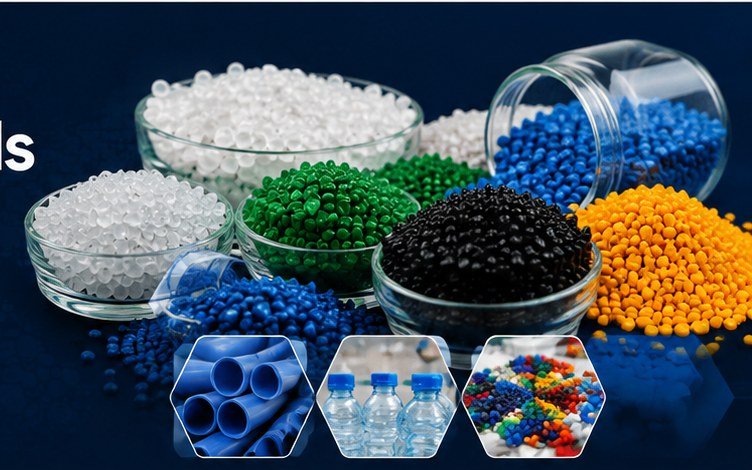
Choosing a plastic should start with the job the finished part has to perform, not with a resin name. Two materials can both be described as “durable” while behaving very differently under heat, impact, chemicals, moisture or repeated loading. A useful material decision connects the product requirement to the polymer, grade, processing method and expected service environment.
1. Start with the part, not the polymer
Write a short requirement sheet before comparing materials. Record what the part must carry, how it will be used, how long it should last and what would count as failure. For a bottle, that might mean drop resistance and chemical compatibility. For a machine cover, stiffness, appearance and temperature may matter more.
| Question | Why it matters |
|---|---|
| What load does the part see? | Separates flexible, tough and stiffness-focused options. |
| What temperature range is expected? | Polymer stiffness and dimensions can change significantly with temperature. |
| Will it contact chemicals? | Compatibility depends on the actual chemical, concentration, temperature and exposure time. |
| How will it be manufactured? | The same polymer family may have different grades for injection molding, extrusion, blow molding or other processes. |
| What happens at end of life? | Material choice can affect sorting, reuse and recycling options. |
2. Check the service temperature
Do not select a resin from its melting point alone. A part can lose useful stiffness long before the polymer melts, and long-term loading can produce creep. Look at the expected continuous temperature, short-term peaks and whether the part is loaded while hot. Supplier data for the specific grade is more useful than a generic polymer-family number.
3. Match mechanical behaviour to the failure you care about
Strength, stiffness, toughness and elongation describe different behaviours. A rigid material is not automatically impact resistant, and a very tough material may not provide the stiffness needed for a thin structural component. For a real product, consider the geometry as well as the resin because ribs, wall thickness, corners and weld lines can change performance.
Good material selection is usually a process of eliminating unsuitable options before ranking the remaining candidates.
4. Consider chemical and environmental exposure
Make a list of everything the part will contact: water, oils, detergents, fuels, acids, alkalis, cleaning agents, UV exposure and humidity. Then check compatibility for the actual concentration and temperature. A polymer that performs well in a laboratory test can behave differently when a part is stressed, exposed for months or subjected to repeated cleaning.
5. Choose the manufacturing route early
Material and process should be considered together. Injection molding rewards grades that fill the selected geometry reliably and release from the mold. Extrusion needs a grade with suitable melt behaviour and stability for the profile. Blow molding, thermoforming and rotational molding each impose their own requirements. A material that looks excellent on a datasheet may be difficult or expensive to process into the intended shape.
6. Compare total cost, not only resin price
Material price is only one part of the product cost. Include scrap, drying, additives, colorant, cycle time, tooling, energy, quality testing and rejected parts. A slightly more expensive resin can be the better choice if it reduces wall thickness, cycle time, failure rate or processing problems.
7. Build a shortlist and test it
A practical shortlist usually contains two or three candidate grades rather than ten polymer families. Define a small validation plan: process representative parts, measure critical dimensions, check appearance and part weight, and test the properties that matter to the product. Keep the resin grade, lot, processing conditions and test result together so the decision can be reproduced.
8. Think about end of life before the design is locked
Ask whether the part can remain a clean material stream, whether labels or inserts complicate recovery, and whether different polymers are permanently joined. Recycling is not only a question of the resin identification code; product construction and contamination can determine whether recovery is practical.
Quick decision checklist
- Define the main failure mode.
- Set the real service-temperature range.
- List chemical, moisture and UV exposure.
- Choose the manufacturing process and geometry together.
- Compare complete production cost.
- Check the specific supplier grade datasheet.
- Validate with representative parts before production approval.
- Document why the final material was selected.
Final takeaway
The best plastic is the one that meets the product requirement with a controllable manufacturing process and a sensible lifecycle. Polymer family, grade, additives, geometry and processing conditions all work together. Treat a datasheet as the starting point for a decision, then confirm the final choice with testing and the current documentation for the exact grade.
Sources to consult
For a production decision, consult the current technical data sheet and processing guide from the resin supplier, the applicable ASTM or ISO test methods, and any food-contact, drinking-water, automotive or other regulations that apply to the product.
How to use this guide
This page is designed to explain the relevant material, process, decision point or failure mode in practical terms. It is meant to support understanding, not replace a current supplier datasheet, process validation, regulatory requirement or engineering sign-off.
Typical material behavior, common process logic, defect patterns, material comparisons and practical decision framing.
Exact product specifications, grade-specific values, regulatory opinions, food-contact validation or factory-specific trials.
Before a production or commercial decision is made, check the exact grade, processing window, standards and local rules that apply to your application.